

'%3e%3cpath%20d='M12%2020.3333C16.6024%2020.3333%2020.3333%2016.6024%2020.3333%2012C20.3333%207.39762%2016.6024%203.66666%2012%203.66666C7.39763%203.66666%203.66667%207.39762%203.66667%2012C3.66667%2016.6024%207.39763%2020.3333%2012%2020.3333Z'%20stroke='%23F2F2F2'%20stroke-width='2.08333'%20stroke-linecap='round'%20stroke-linejoin='round'/%3e%3cpath%20d='M8.66667%2013.6667C8.66667%2013.6667%209.91667%2015.3333%2012%2015.3333C14.0833%2015.3333%2015.3333%2013.6667%2015.3333%2013.6667'%20stroke='%23F2F2F2'%20stroke-width='2.08333'%20stroke-linecap='round'%20stroke-linejoin='round'/%3e%3cpath%20d='M9.5%209.5H9.50833'%20stroke='%23F2F2F2'%20stroke-width='2.08333'%20stroke-linecap='round'%20stroke-linejoin='round'/%3e%3cpath%20d='M14.5%209.5H14.5083'%20stroke='%23F2F2F2'%20stroke-width='2.08333'%20stroke-linecap='round'%20stroke-linejoin='round'/%3e%3c/g%3e%3cdefs%3e%3cclipPath%20id='clip0_10282_1064'%3e%3crect%20width='20'%20height='20'%20fill='white'%20transform='translate(2%202)'/%3e%3c/clipPath%3e%3c/defs%3e%3c/svg%3e)


A powerful goddess in a dark blue hooded robe holds a flaming torch, standing amidst ancient ruins under a starry night sky.
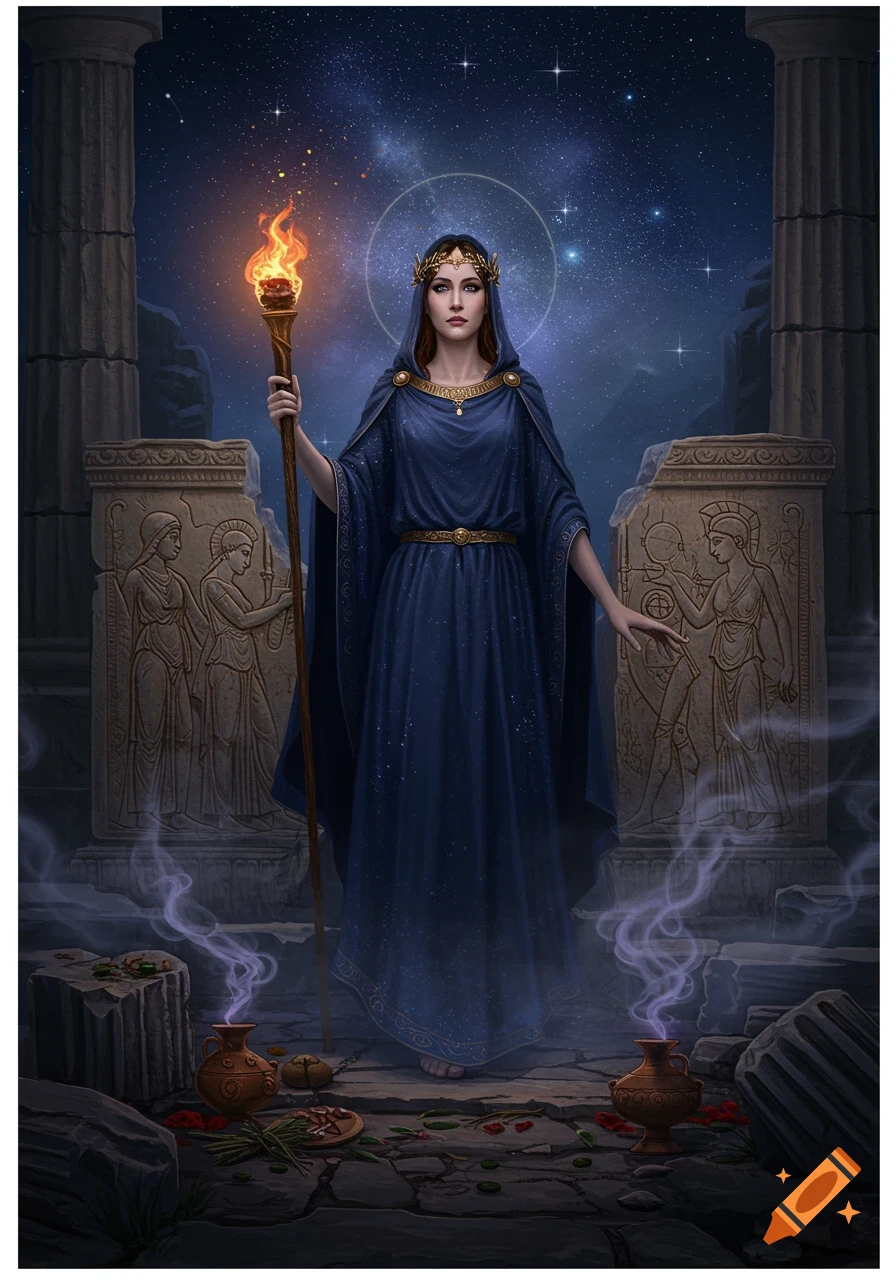
Hecate, she who treadeth betwixt realms—not only of sorcery and shadow, but of law, safeguard, and cosmic harmony. The torchbearer at crossroads, verily, yet also the warden of portals, both mortal and divine. In the sanctuary of Lagina, she is venerated not as a queen of witches, but as Soteira—the deliverer of cities, the celestial envoy who doth mediate betwixt empires and upholdeth civic freedom. Her temple friezes depict her not in triplicate form, but as singular and sovereign, bestowing libations ’twixt warriors and Amazons, embodying balance and bond. In the Orphic Hymns, she is the sovereign of night, shrouded in enigma, guiding souls o’er the veil of death. She is summoned with flame and blood, protector of the sacred and profane. The Greek Magical Papyri do murmur her manifold names—Chthonia, Phosphoros, Trimorphos—calling her to guard thresholds, conjure spirits, and command the unseen. Yet in the Chaldean Oracles, she transcendeth divine. She is Anima Mundi, the essence of the cosmos, the axis through which divine fire doth flow into form. Neither wholly Olympian nor purely chthonic, Hecate is time's hinge—where fate, liberty, and mystery doth converge. She is not merely the goddess of witches. She is the goddess of confines—political, spiritual, metaphysical. To know Hecate is to stand at the brink of that which is known, and to kindle a torch into the abyss. See more
More images like this
