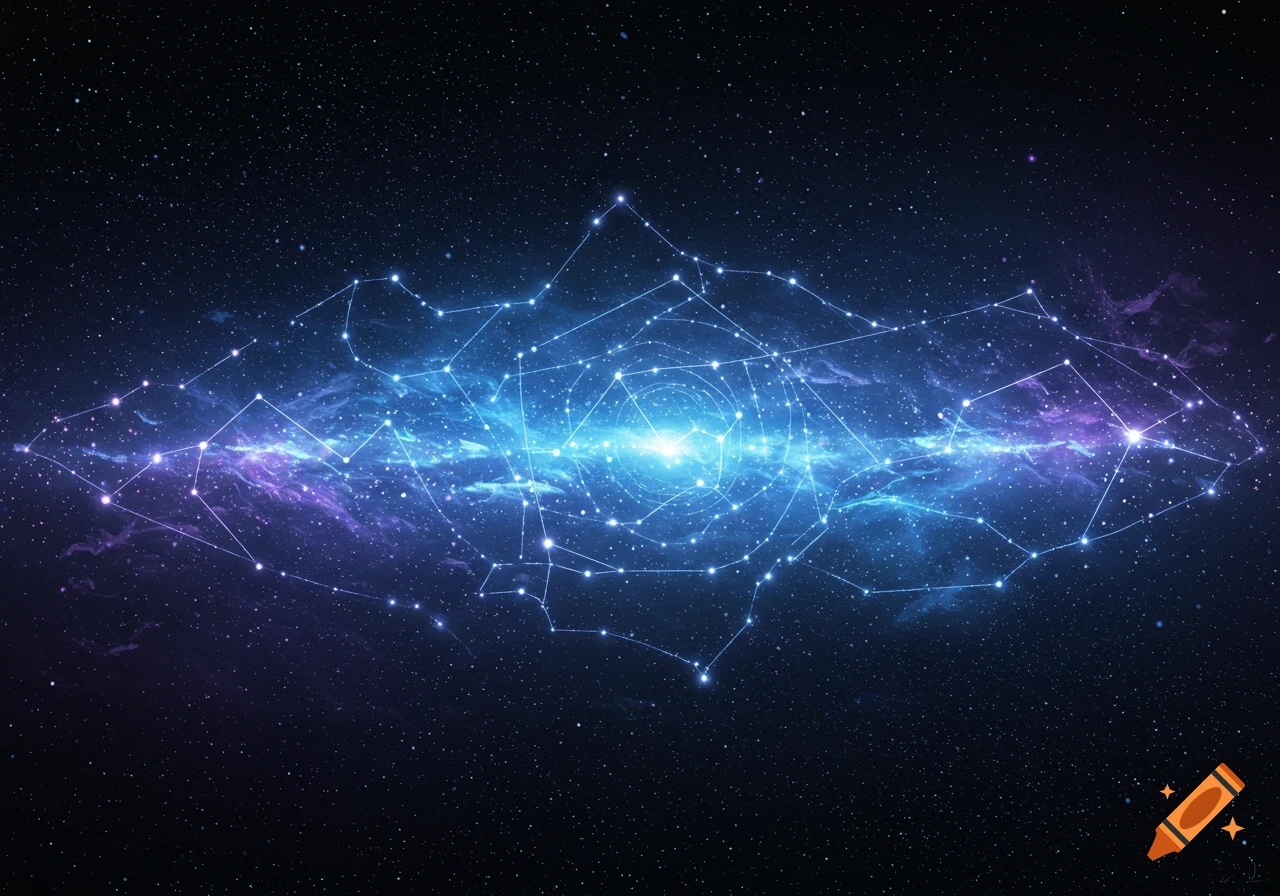
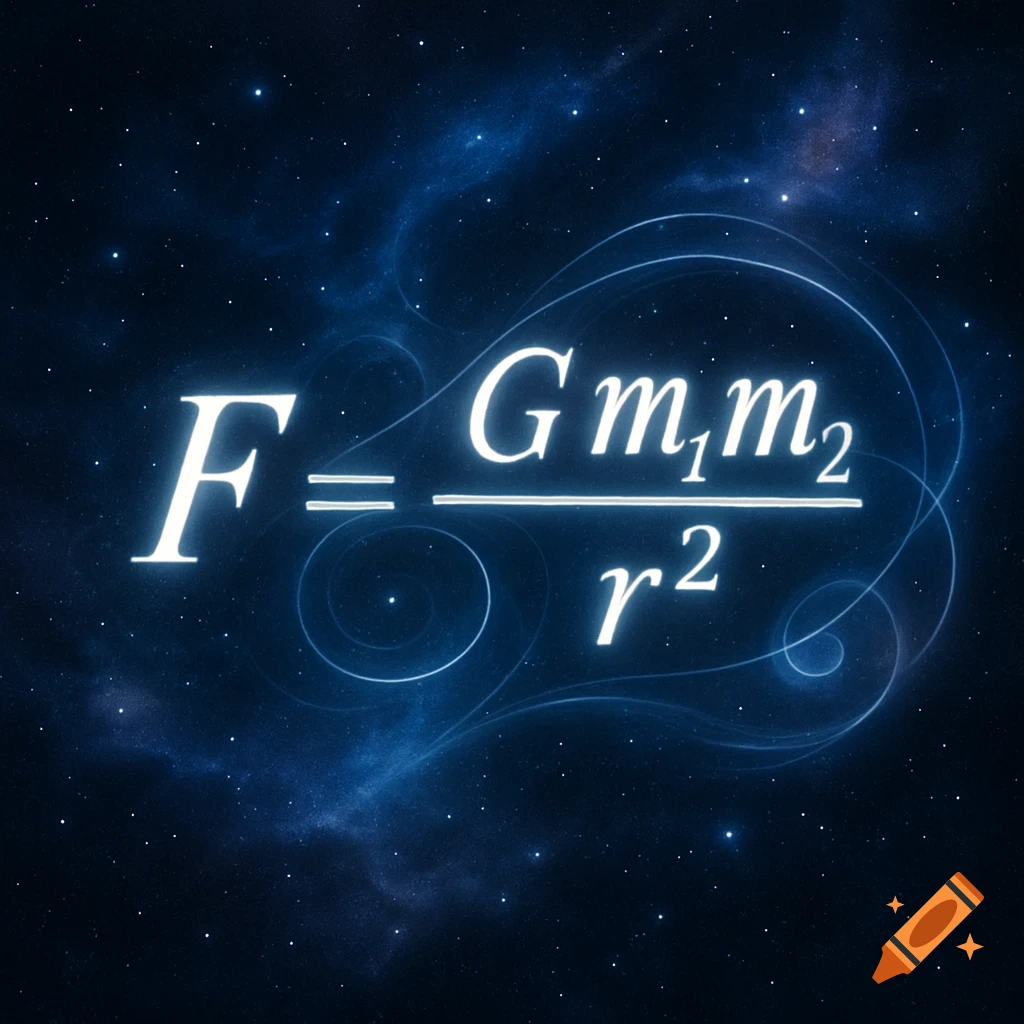
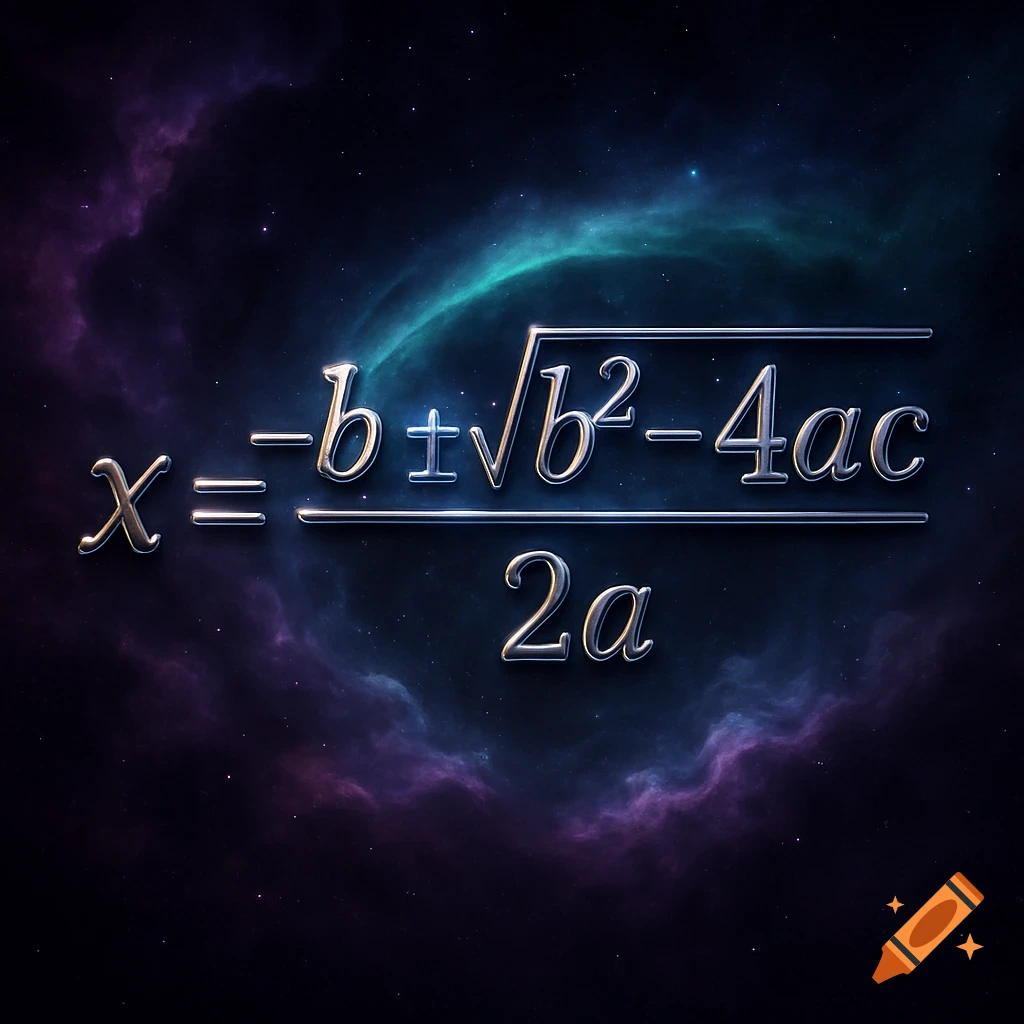
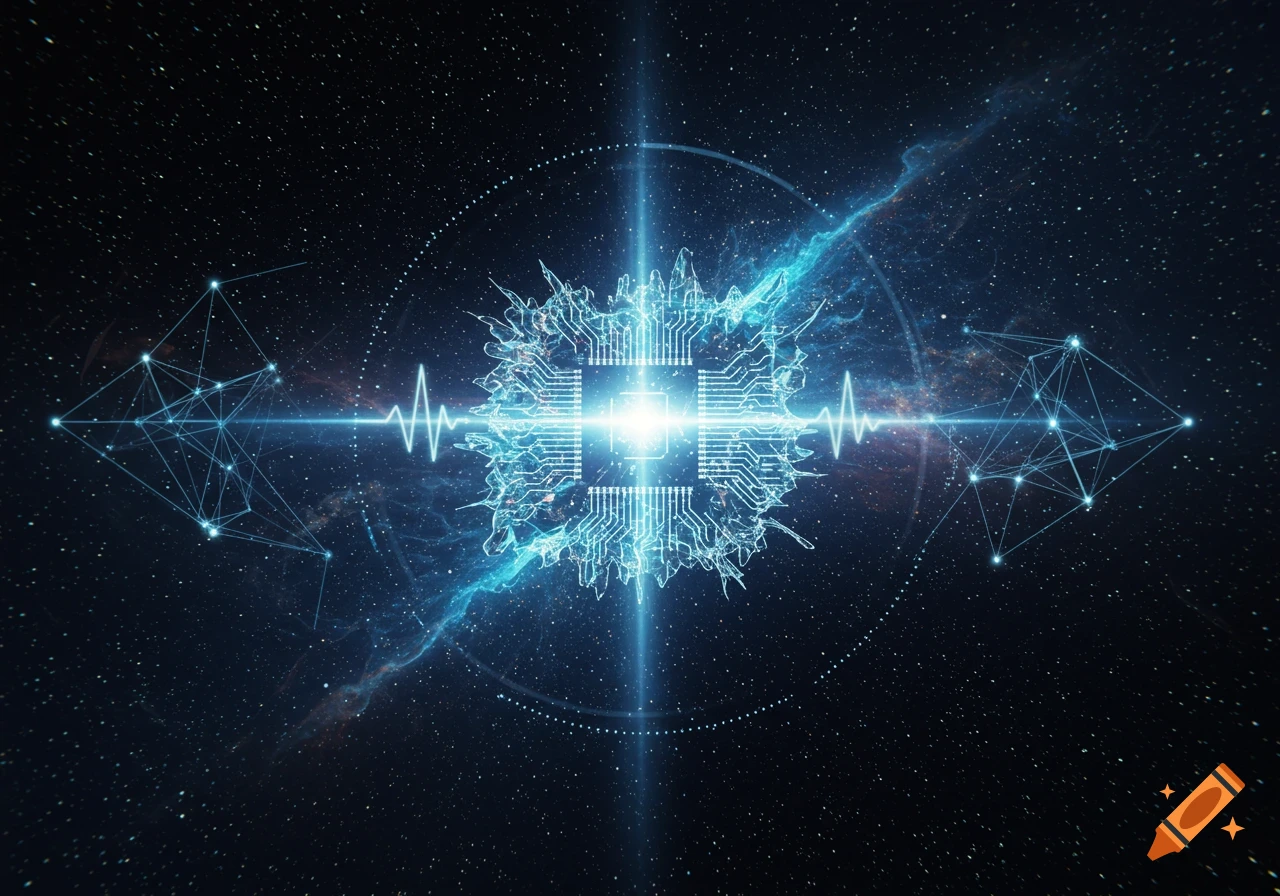
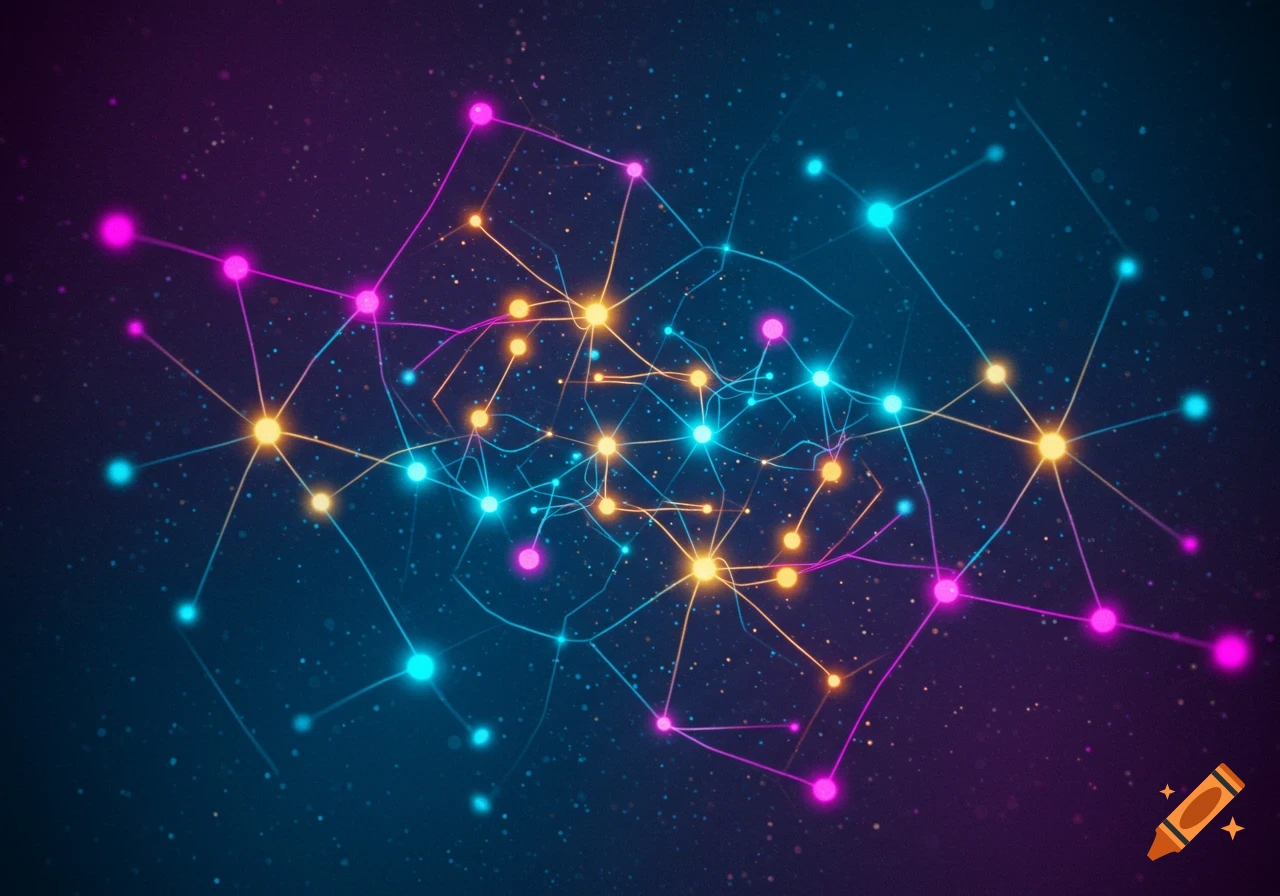
A luminous blue and white network of interconnected nodes against a dark blue, star-filled cosmic background with a mathematical formula rendered in white text.
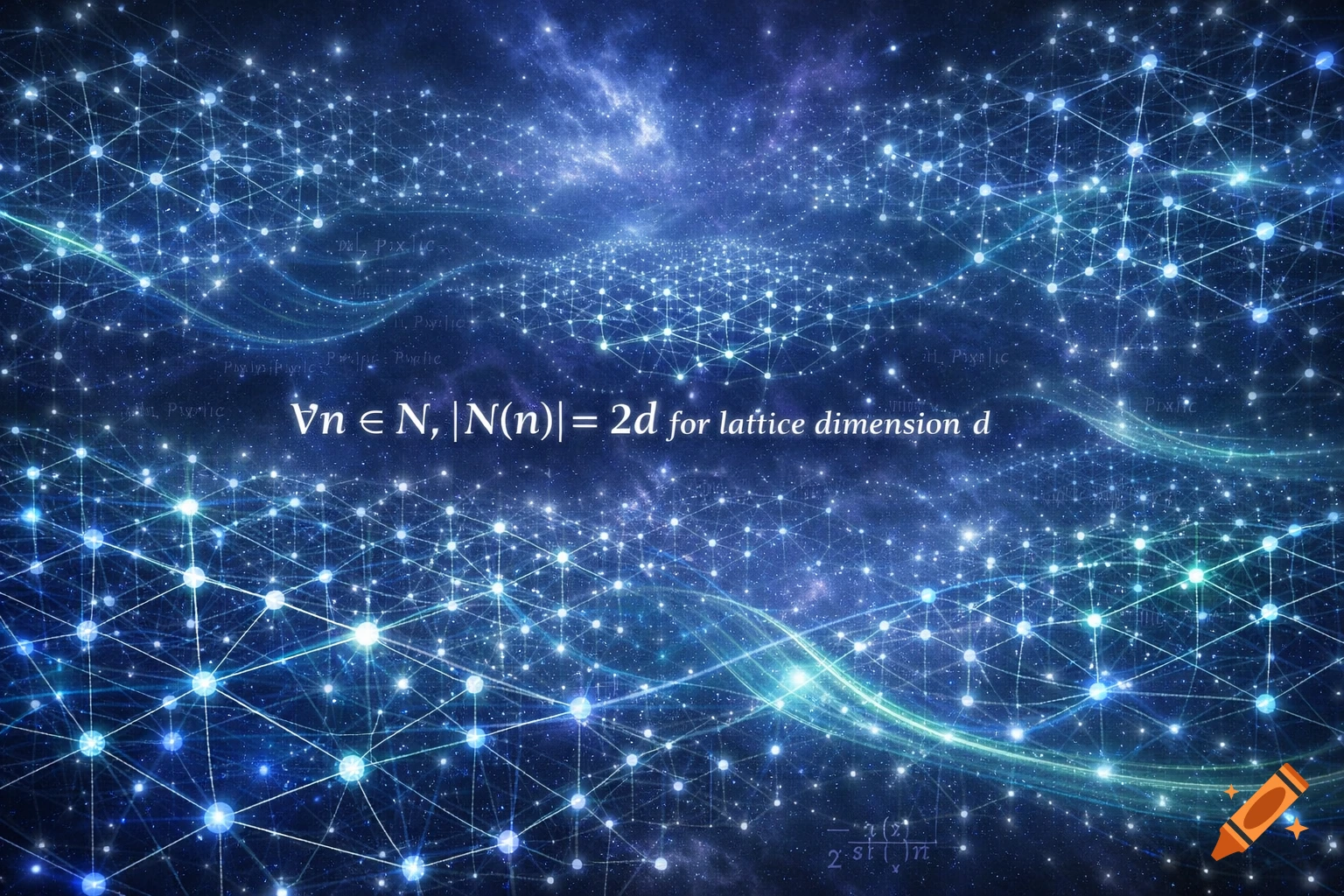
3.7 Optional Notes / Extensions Higher-Dimensional Hexagonal Lattices The 2D/3D hexagonal lattice can be extended to 4D or higher, exploring emergent curvature and topology in extra dimensions. Symbolically: ∀n∈N,∣N(n)∣=2dfor lattice dimension d\forall n \in N, \quad |N(n)| = 2d \quad \text{for lattice dimension } d∀n∈N,∣N(n)∣=2dfor lattice dimension d This allows theoretical comparisons with string-theoretic or Kaluza-Klein compactifications. Dynamic Node Coupling Variable adjacency weights wnmw_{nm}wnm can represent fluctuating wormhole strength or entanglement variability: ρ(n)=∑m∈N(n)wnmρ(m)∑m∈N(n)wnm\rho(n) = \frac{\sum_{m \in N(n)} w_{nm} \rho(m)}{\sum_{m \in N(n)} w_{nm}}ρ(n)=∑m∈N(n)wnm∑m∈N(n)wnmρ(m) This models local instabilities and self-healing lattice behavior. Probabilistic Multiverse Weighting Forward-consistent path amplitudes A(Pi)\mathcal{A}(P_i)A(Pi) can be extended to probability distributions: P(Pi)=∣A(Pi)∣2∑j∣A(Pj)∣2\mathbb{P}(P_i) = \frac{|\mathcal{A}(P_i)|^2}{\sum_j |\mathcal{A}(P_j)|^2}P(Pi)=∑j∣A(Pj)∣2∣A(Pi)∣2 This bridges the lattice conceptually with quantum cosmology and Many-Worlds interpretations. Curvature-Dependent Lattice Evolution The adjacency matrix AAA can depend on local curvature κ(n)\kappa(n)κ(n): Anm=f(κ(n),κ(m))A_{nm} = f(\kappa(n), \kappa(m))Anm=f(κ(n),κ(m)) This captures potential self-organizing principles of spacetime at Planck scales. Information-Theoretic Constraints Entropy or mutual information metrics can Mehr sehen
More images like this