

'%3e%3cpath%20d='M12%2020.3333C16.6024%2020.3333%2020.3333%2016.6024%2020.3333%2012C20.3333%207.39762%2016.6024%203.66666%2012%203.66666C7.39763%203.66666%203.66667%207.39762%203.66667%2012C3.66667%2016.6024%207.39763%2020.3333%2012%2020.3333Z'%20stroke='%23F2F2F2'%20stroke-width='2.08333'%20stroke-linecap='round'%20stroke-linejoin='round'/%3e%3cpath%20d='M8.66667%2013.6667C8.66667%2013.6667%209.91667%2015.3333%2012%2015.3333C14.0833%2015.3333%2015.3333%2013.6667%2015.3333%2013.6667'%20stroke='%23F2F2F2'%20stroke-width='2.08333'%20stroke-linecap='round'%20stroke-linejoin='round'/%3e%3cpath%20d='M9.5%209.5H9.50833'%20stroke='%23F2F2F2'%20stroke-width='2.08333'%20stroke-linecap='round'%20stroke-linejoin='round'/%3e%3cpath%20d='M14.5%209.5H14.5083'%20stroke='%23F2F2F2'%20stroke-width='2.08333'%20stroke-linecap='round'%20stroke-linejoin='round'/%3e%3c/g%3e%3cdefs%3e%3cclipPath%20id='clip0_10282_1064'%3e%3crect%20width='20'%20height='20'%20fill='white'%20transform='translate(2%202)'/%3e%3c/clipPath%3e%3c/defs%3e%3c/svg%3e)


An array of legal evidence, including open briefcase with documents, a tablet with a witness statement, forensic tools, and a crime scene diagram on a wooden desk in a courtroom.
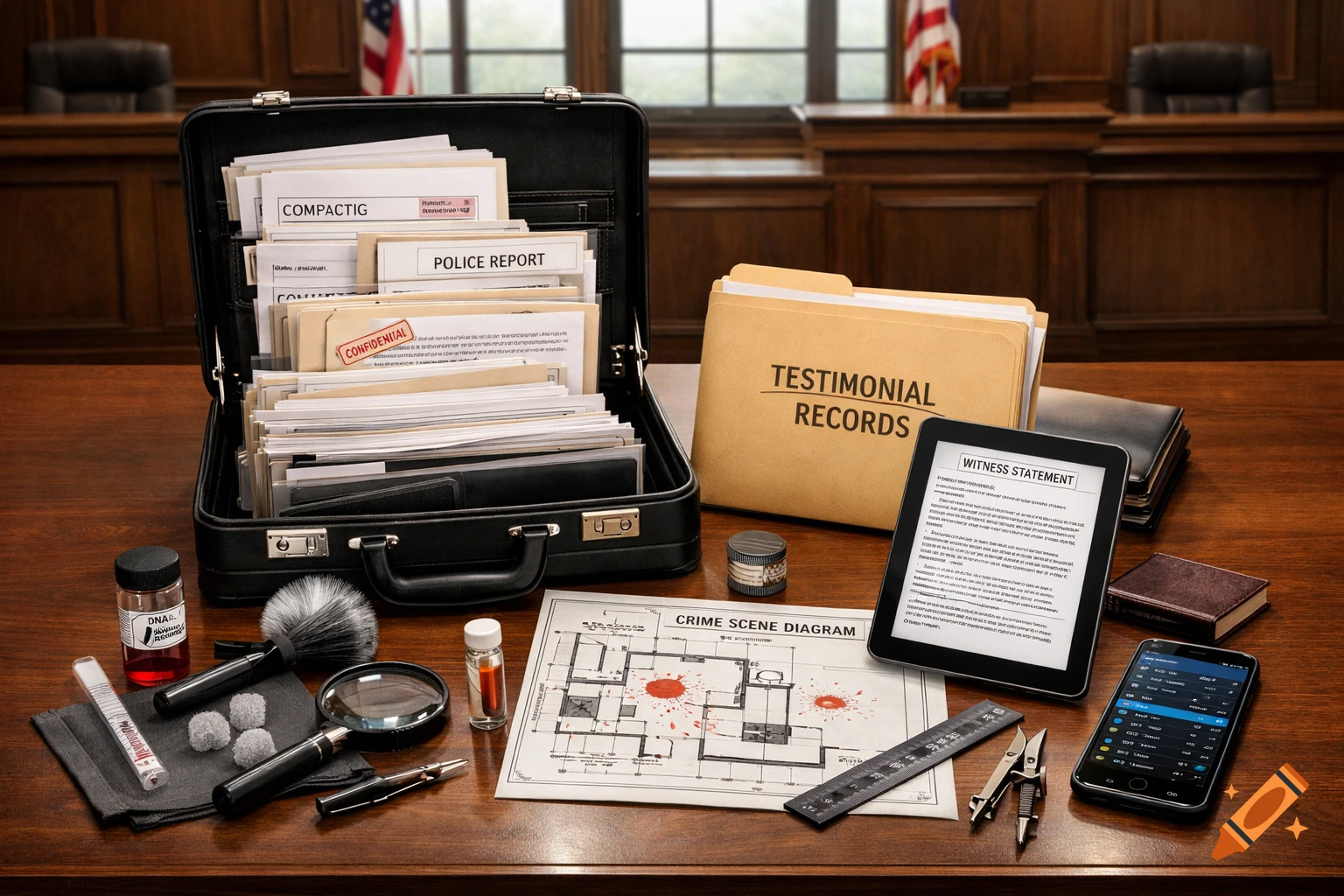
Legal Evidence Legal evidence is the information presented in a court of law to prove or disprove facts in a legal case. It plays a crucial role in both civil and criminal proceedings, as it helps judges and juries establish the truth and reach a fair decision. There are several types of legal evidence: Testimonial evidence — statements made by witnesses under oath. This includes eyewitness accounts and expert testimony (e.g., from forensic specialists or psychologists). Documentary evidence — written materials such as contracts, emails, medical records, police reports, or any other documents relevant to the case. Physical (real) evidence — tangible objects connected to the case: weapons, clothing, fingerprints, DNA samples, or surveillance footage. Demonstrative evidence — visual or auditory aids that illustrate facts (e.g., maps, charts, diagrams, or reenactments). Digital evidence — data from electronic devices: emails, social media posts, GPS logs, or metadata from smartphones. For evidence to be admissible in court, it must meet specific criteria: Relevance: it must relate directly to the facts in dispute. Reliability: the evidence should be trustworthy and accurate. Competence: it must be obtained legally (e.g., without violating constitutional rights). Hearsay rule: generally, second‑hand statements are not admissible unless an exception applies (e.g., dying declarations or business records). The weight of evidence depends on its credibility and strength. For Mehr sehen
More images like this
