

'%3e%3cpath%20d='M12%2020.3333C16.6024%2020.3333%2020.3333%2016.6024%2020.3333%2012C20.3333%207.39762%2016.6024%203.66666%2012%203.66666C7.39763%203.66666%203.66667%207.39762%203.66667%2012C3.66667%2016.6024%207.39763%2020.3333%2012%2020.3333Z'%20stroke='%23F2F2F2'%20stroke-width='2.08333'%20stroke-linecap='round'%20stroke-linejoin='round'/%3e%3cpath%20d='M8.66667%2013.6667C8.66667%2013.6667%209.91667%2015.3333%2012%2015.3333C14.0833%2015.3333%2015.3333%2013.6667%2015.3333%2013.6667'%20stroke='%23F2F2F2'%20stroke-width='2.08333'%20stroke-linecap='round'%20stroke-linejoin='round'/%3e%3cpath%20d='M9.5%209.5H9.50833'%20stroke='%23F2F2F2'%20stroke-width='2.08333'%20stroke-linecap='round'%20stroke-linejoin='round'/%3e%3cpath%20d='M14.5%209.5H14.5083'%20stroke='%23F2F2F2'%20stroke-width='2.08333'%20stroke-linecap='round'%20stroke-linejoin='round'/%3e%3c/g%3e%3cdefs%3e%3cclipPath%20id='clip0_10282_1064'%3e%3crect%20width='20'%20height='20'%20fill='white'%20transform='translate(2%202)'/%3e%3c/clipPath%3e%3c/defs%3e%3c/svg%3e)


Detailed, vibrant illustration of cellular catabolism, showing digestion, glycolysis, Krebs cycle, and electron transport with labeled molecules and organs.
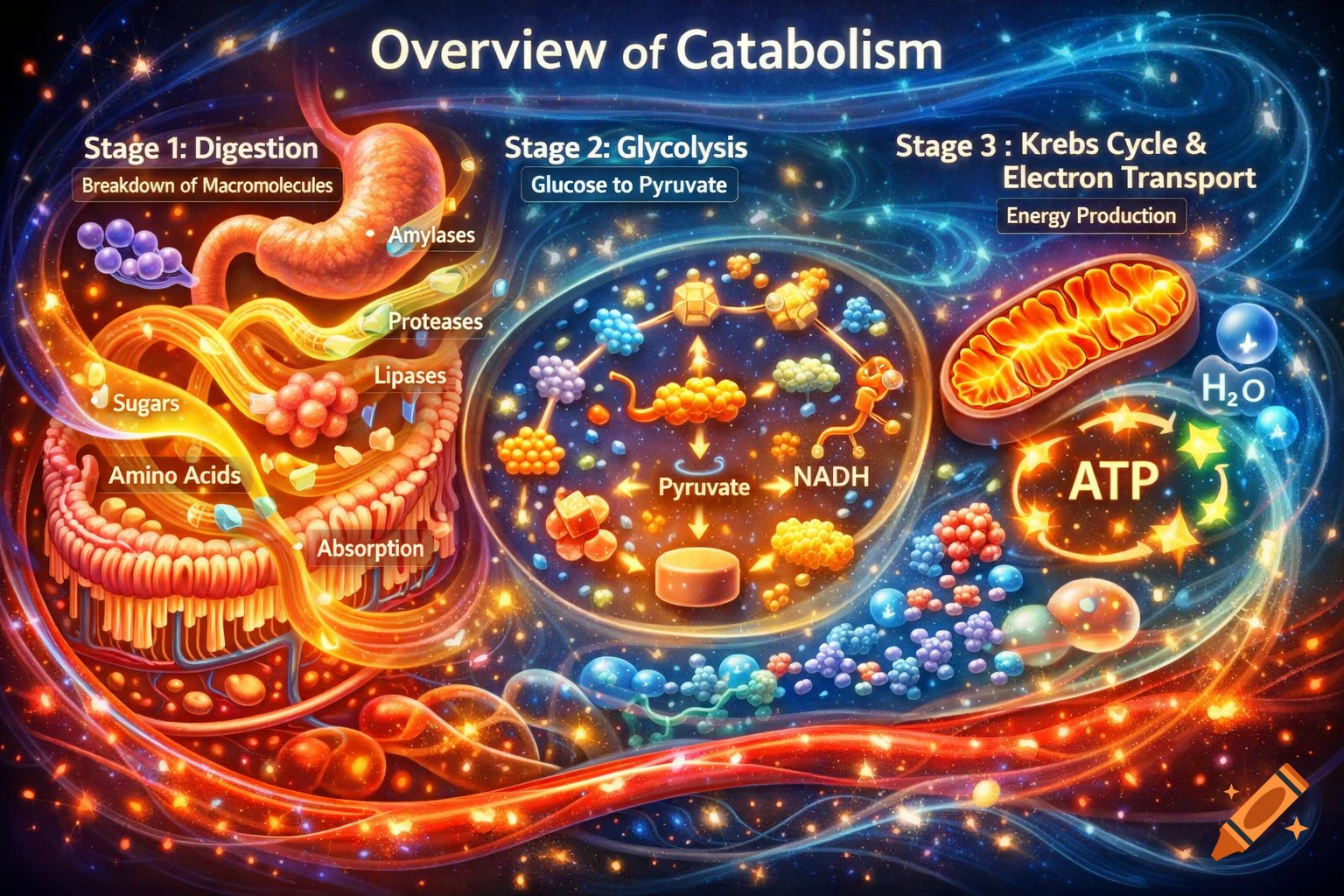
# Cellular Catabolism: Three-Stage Energy Production ## Overview of Catabolism - **Catabolism**: The process of breaking down macromolecules to produce energy (ATP, NADH, FADH₂) - Three sequential stages convert foodstuffs into cellular energy - Later stages require oxygen—this is why you breathe ## Stage 1: Digestion (Breakdown of Macromolecules) - **Location**: Digestive tract and lysosomes - **Function**: Breakdown of macromolecules into simple subunits - **Enzymes involved**: - **Amylases**: Hydrolyze starch into sugars (produced by salivary glands) - **Proteases** (e.g., pepsin): Hydrolyze polypeptides into amino acids (most active at low pH in stomach) - **Lipases**: Hydrolyze fats and oils into fatty acids (produced by pancreas) - **Cofactors**: Low pH (H⁺) and Cl⁻ in the stomach - **Energy generated**: Does NOT generate ATP - **Product molecules**: Amino acids, sugars, fatty acids - Bile (from liver) emulsifies fats to increase surface area for lipase action - Products are absorbed by epithelial cells in intestines and transported by bloodstream ## Stage 2: Glycolysis (Glucose Breakdown) - **Location**: Cytosol - **Function**: Breakdown of glucose molecules to pyruvate - **Enzymes involved**: 10 distinct enzymes - **Oxygen requirement**: Does NOT require oxygen (anaerobic process) - **Products**: - Pyruvate (3-carbon molecule) - Limited ATP (small amounts) - NADH (carries high-energy electrons) - **Additional role**: Generates precursor molecules for synthesis of Mehr sehen
More images like this
